Such an inspiring milestone for migration studies in Pakistan! The inaugural webinar of the Migration Research Network Pakistan (MRNP) has officially launched, creating a vital platform to map and connect scholars working on Pakistan worldwide. It is incredibly rewarding to see this initiative brought to life by the Migration Research Cell at the University of Peshawar, alongside CIMRAD at the Lahore School of Economics. Thank you, everyone, for your participation.
After the launch, the webinar highlighted compelling research on climate displacement in Pakistan, exploring informal support networks in remote areas and offering valuable academic insights.
The Power of Informal Networks: In vulnerable regions such as Chitral, the first line of defence during climate emergencies isn’t always formal state infrastructure. Instead, neighbours, extended family, and local community-based organisations step up to provide immediate shelter, food, and the physical labour required to clear debris.
The Need for Synergy: While local informal networks and INGOs handle much of the work, significant gaps remain. Poor coordination among NGOs and government causes duplicated efforts, wasted resources, and delays assistance to those in need.
Expectations from the State: Despite criticism of slow or inadequate governmental support, communities expect the government to act.
Moving Beyond Immediate Relief: Prolonged internal displacement persists when recovery programs are temporary, poorly coordinated, and exclude communities. Genuine recovery requires long-term capacity building driven by social and political capital.
The Policy and Climate Finance Gap: Climate displacement is currently within a bureaucratic gap with no clear authority responsible for national oversight. Despite billions in climate funding, resources rarely target planned relocations or displacement. There is an urgent need for dedicated mechanisms to help communities access and allocate these funds.
This emphasizes why launching MRNP now is crucial. By combining our expertise, we can create evidence for sustainable change, not quick fixes. Excited for impactful collaborations!
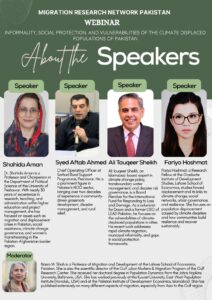
Summary of the Inaugural Webinar of the Migration Research Network Pakistan
The Migration Research Network Pakistan held ifts inaugural webinar on informal social protection for climate-displaced communities in Chitral, Khyber Pakhtunkhwa, and Matiari, Sindh.
The webinar began with an introduction by Dr. Ayub Jan, who formally introduced the Migration Research Network Pakistan. He explained that the network is a joint initiative of the Migration Research Cell at the University of Peshawar and the Centre on International Migration, Remittances and Diaspora at the Lahore School of Economics. He also introduced the network’s website, which provides information about the network, its members and their research interests. The website includes a membership directory and a “Join the Network” section through which researchers and professionals working on migration-related issues can apply to become members.
Dr. Shahida Aman presented findings from research conducted in Rashun and Chewdok in Chitral. She explained that displaced households mainly depended on neighbours, relatives and friends for shelter, food and labour. In some cases, families stayed with neighbours for more than six months. Community-based organisations, local youth groups and organisations supported by the Red Crescent also played an important role. However, the work of these local organization was affected by limited government resources and weak coordination between local organisations and international NGOs.
The findings showed that NGOs were generally considered more effective than government institutions. In Chewdok, where major international NGOs were largely absent, faith-based organisations such as Al-Khidmat provided much of the assistance. Residents of Chewdok were found to be more vulnerable than those in Rashun because of poverty, low literacy among women, weak community networks and limited NGO presence. Around 90 percent of displaced households reportedly rebuilt their homes using personal savings or loans because government assistance was insufficient. Despite this dissatisfaction, communities continued to expect the state to take primary responsibility for their protection and recovery.
Syed Aftab Ahmed of the Sarhad Rural Support Programme discussed how climate change affects mountain communities in Khyber Pakhtunkhwa. He explained that flash floods, landslides and glacial lake outburst floods gradually destroy livelihoods, agricultural land and irrigation systems. This slow loss of resources eventually forces families to migrate. He highlighted examples of communities rebuilding irrigation channels several times without outside assistance.
He argued that conventional cash transfers are not enough to address climate-related displacement. Instead, communities require climate-resilient infrastructure, diversified livelihoods and strong local institutions. He also discussed SRSP’s climate-risk financing initiative, introduced through community investment funds and women’s village banks, to help households recover more quickly after climate shocks.
Fariya Hashmat presented research on households displaced by the 2022 floods in Matiari District, Sindh. She noted that Pakistan experienced millions of internal displacements caused by climate-related disasters between 2008 and 2025, with floods accounting for most. Several families affected by the 2022 floods continue to face prolonged displacement because recovery programmes have often been temporary, poorly coordinated and designed without sufficient community participation.
Her study used social quality and social capital theories to examine how displaced households move through different stages of recovery, including absorptive, adaptive and transformative capacity. The findings showed that political connections can play an important role in determining access to assistance. Households with stronger political capital sometimes acted as gatekeepers and helped other vulnerable households obtain support. The study also found that some families used displacement as an opportunity to improve their situation, while others remained highly vulnerable because of limited financial, social, and political resources.
Ali Tauqeer Sheikh discussed loss and damage financing in relation to climate displacement. He distinguished between adaptation, which addresses risks that can still be managed or reduced, and loss and damage, which refers to irreversible economic and non-economic losses. These may include the loss of cultural heritage, languages, ancestral land and graveyards.
He highlighted the growing displacement risks associated with glacial lakes in Gilgit-Baltistan and noted that non-economic losses are rarely documented or compensated. He also explained that displacement is not adequately treated as a separate planning and budgeting category in Pakistan’s policy documents. Large development portfolios supported by institutions such as the World Bank and Asian Development Bank also provide limited support for planned relocation. He stressed that future proposals to the Loss and Damage Fund should give greater attention to displacement and human mobility.
A major issue highlighted during the webinar was the absence of a clearly designated government institution responsible for displacement in Pakistan. Displacement is neither formally assigned to the federal government nor clearly devolved to provincial governments. As a result, no ministry or department has full responsibility for coordinating policy, planning, budgeting and assistance for displaced communities.
The discussion also addressed differences in resilience between Rashun and Chewdok, the inclusion of Afghan refugees and other outsiders in informal support systems, and the risk of romanticising community resilience. Participants noted that praising communities for their ability to cope may sometimes hide the long-term insecurity, poverty and lack of institutional support they experience.
The webinar concluded with recommendations to engage provincial planning departments and nominate focal persons for migration and displacement. Researchers were also encouraged to explore future funding opportunities under the Loss and Damage Fund and to submit suggestions for upcoming webinars of the Migration Research Network Pakistan.